
“Be afraid.”
Menace under the Constitutional order.

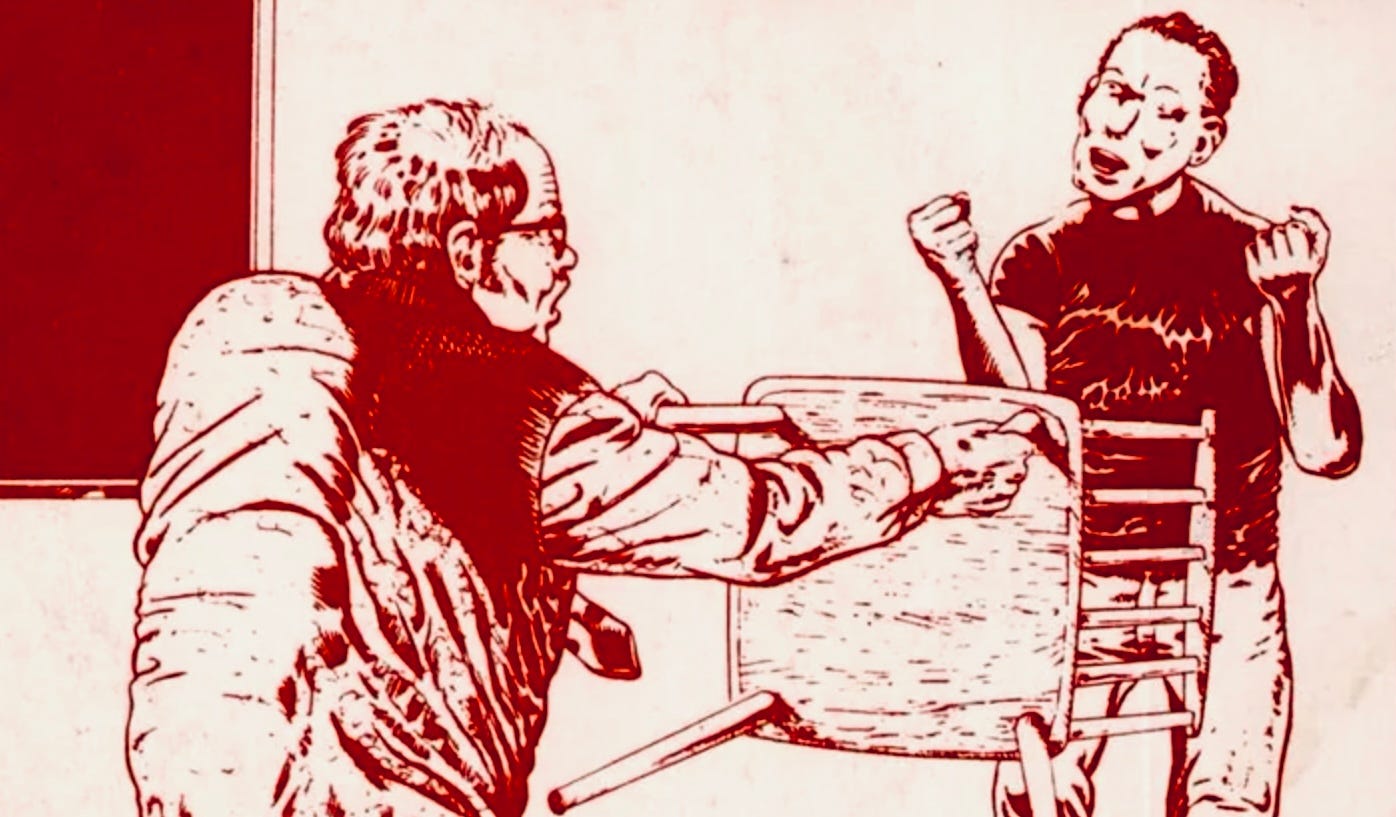
America is under siege by a force I like to call the Hazmat Crew. People who look upon our founding traditions and the words that lay them down as being in a condition akin to catastrophe. They are spoiled by all manner of toxic uncleanness, whether sewage, chemical runoff, or human remains. Worse is the belief that they were slathered on purpose, by their fellow citizens. None more so than our own Constitution, which they give special attention. More special still our much mistreated First and Second Amendments in the Bill of Rights.
You see, to them we make too much of the Bill of Rights. We regard it alternately like an idol and like a plaything. We bestow it with fawning reverence one moment, lurid eroticism the next. The Bill of Rights is America’s jizz rag. We fail to appreciate its finer points. The subtle technical qualities—its literal-fucking-meaning—that inhibit our actions rather than enable them. The Bill of Rights above all other American documents, the Hazmat Crew attests, must be sterilized in the aromatic purity of bleach and peroxide.
But the Hazmat Crew is a complicated group. They work in two shifts and make it a point to never interact. The day shift is liberal and focuses on cleaning the Second Amendment. The night shift is conservative and focuses on the First. And they also work very differently.
The night shift is understaffed but has an exacting manager: the brilliant but vertiginous 20th century political scientist Willmoore Kendall. Amid the broad chaos of his written output are pieces for the reader to assemble into a sustained and rigorous demystification of “free speech,” a project not merely unfinished but never fully attempted. The Bill of Rights, Kendall said, was nothing more than a political concession by one faction to another. The First Amendment therein is not a permission slip for your mind and mouth to think and say whatever. That’s Millsian talk and not suitable to America. You have no more rights beyond petitioning for grievances. The community reserves the right to “run you out of town on a rail” if you push their limits. The Bill of Rights is in truth a Charter of Ultimatums.
The day shift, to my knowledge, has either too many managers or none at all. It is the most overstaffed and most vocal shift, reflective of liberalism’s mainstream position and anxieties toward particular genres of public violence. The Second Amendment grants no more than the First. Want a weapon as a private citizen? Well, look at the wording. Join a militia, get the guns. Too bad there are no real militias anymore. If you don’t understand that on your own, the ATF will gladly assist you.
So what’s the problem, you might ask? How is this pedantry a threat against the longstanding Constitutional affirmation favored by the courts? Fair enough. Our judiciary is sanguine about giving American citizens considerable latitude in ordering their lives. Justice Thomas has been a consistent absolutist, affirming that we are just as free to keep and bear assault weapons as we are in making and consuming the most vile pornography this side of Sade. It is virtually a tradition of its own at this point; one in keeping with progress and not accommodating of negationist backsliding. It seems all the more underwhelming as the shifts of the Hazmat Crew don’t seem to get along. But in a moment of political realignment that may change. Especially once they recognize what truly brings them together. Not philosophy or ideology, but mindset. The Hazmat Crew is guided by fear, a fear of people.
More accurately, the Hazmat Crew equates freedom with irresponsibility. Also, apparently, with deficient literacy. Courts and citizens alike heap meaning upon meaning onto our laws that render the clarity of the words in greater opacity. Not only is language itself threatened, but it risks corrupting the collective good sense of the people. It’s a view not without potential to gain wider sympathy. People who cherish their affirmative freedoms cannot rely on Constitutional latitude to defend against it, let alone survive it. That is on you as citizens to resist, and who are in need of a more resistant metaphor.
Think of our Constitutional order not as a chaotic, contaminated scene, but a high, elegant, and sharply lined precipice overlooking a vast, deep, and black canyon. There are no guardrails separating you from the canyon. You as an individual imbued with agency are not prevented from walking to the precipice and leaping into the canyon, which we conceive as Total Freedom. Of course Total Freedom, wherein every one of your thoughts are given license to action, is a state of insanity and is truly a place free of a citizen’s responsibility. What the Constitution grants you, and this not even our affirmative courts entirely grasp, is your ability to scale the incline all the way to the edge, to gauge the depth beyond, and ideally to remain at the edge knowing full well the consequences of deciding otherwise. It is the difference between the hostility of the depths, which is beyond the law, and the menace of the edge, which is well within it.
The Constitutional right of menace, like all rights, works in both directions. The classic example of negative menace is the carry permit holder, going about his day while literally keeping and baring his arms. He intends no menace, but by his blatant disregard for those around him, causes menace. Against this menace, the unarmed majority has no recourse. A freedom that menaces out of logical consequence is no less a freedom than one that menaces not at all. Indeed, all the relevant freedoms provoke some level of unease against the many who wish these freedoms to be read rather than seen, if that. But less is said of the freedom to menace. And here we need a different example.
Your daughter’s birthday is coming up. She wants a party with all her friends and the children whose friendship she dearly wants. You grasp the importance of this and love your daughter very much. But you can’t (or won’t) spring for renting the roller rink and you don’t want a hack magician. What are your options? Of course you get a kid-sized karaoke machine and a clown. A clown, you note, with solid Yelp referrals. Things are going well. The kids are rocking Olivia Rodrigo or whatever the fuck they listen to these days, and you’re getting no complaints about the punch and cake. Your daughter is even taking their substandard gifts in stride, princess that she is. Then the clown shows up and the merriment seems to evaporate. Wherever the clown goes, sorrow is not far behind. The entire party is in a kind of frenzy. Your daughter is horrified and your wife isn’t happy either. The goodie bags might as well have copies of the DSM-5 in them. But what can you do? Nothing, and you know it. Because your defects as a father, husband, and consumer are in exact proportion to your virtues as a citizen. For even if you were not fully attentive in your party planning, the clown can do nothing else, be nothing else. Your wife wants badly to sue, but you know the law of menace is not on your side.
It is this expressed right, more than any judicial tinkering, that the Hazmat Crew is desperate to “clean up.” At some level you have to respect their honesty. Most people will grin and bear your menacing insolence and lash out at their undeserving loved ones in private. At least these people want to do something. There is no discourse to exchange, no debate to be aired. There is only a frontal attack by people who hate to see you joyful, who resent that you are free, and who regret that you exist. They will not rest until evidence of the unruly Other is implausible, a myth at best. The world that comes in the wake of your defeat is one as emotionally and intellectually suffocated as they are. But what they wield is a power, not a right. And you can only see it for what it is: the leap over into the canyon of Total Freedom. The citizen’s embrace of insanity made manifest.
It is logical to see the fight against them as requiring nothing more than what you should be doing anyway: proliferating guns and clowns into the civic space. But this only strengthens them. To fight them effectively you must adopt their methods in order to intensify and concentrate your own. You must clean up their mess, and you must rely on the pages of their most articulate messenger. The Liberal, Kendall wrote “rebels against our Tradition …. [C]onstantly putting forward proposals for making it over in their image of what a society should be like—proposals born of their instinctive dislike of the American way of life” and therefore “run up against vigorous and uninterrupted Conservative resistance.”
Such resistance requires a heightened sensitivity to “subversive” forces in our political existence. Kendall, of course, envisioned a polity with the patience to endure lengthy Congressional Committee investigations. You are not so privileged and must rely on your menacing capacity in quite a different way. In which it is less a right than an instrument of defense. As if you play your menace in a major key as a free citizen while playing it in a minor key as a political disputant. The object is to avert subversion away from full-on treason. So while you need not assemble a beclowned firing squad, which in this regime is clearly neither cruel nor unusual, projecting that it is just around the corner upon your opponent is an urgent ploy. In every case your aim and your greatest method of armament is the ability to command to any and all: “Be afraid.”