
Crying in Baseball
Sport as poetry; sport as manipulator.

I’ve heard it said that there is no crying in baseball. It is more a maxim than a rule, and like all maxims its exact origin is as mysterious as its truth is granted. We go into a baseball game secure in the certainty that no crying will take place, and no hint of sadness will be tolerated from the first inning to the 57th. Not crying is the sturdy foundation upon which baseball’s palatial mansion is built. Baseball maxims, again unlike baseball rules, warrant very little thought. But what happens when you do think about it? Does that foundation not seem just a tad shaky? Did you not purchase this beautiful mansion for a suspiciously low asking price? Are not its stairways giving out and its floors crumbling under your feet?
Baseball is a sport. Or so I’m repeatedly told. It doesn’t look like a sport I know. Sure, it involves human people, placed in particular positions on a field of grass arranged in a particular way. But in baseball, the players don’t play. They mostly stand around, moving a few feet at intervals of several minutes. In other words, baseball is a sport in the same way that ambient soundscapes are music. The athleticism dwells within a negative space of static motion.
I remember that I did not move very much when I played baseball. The pants for my uniform were at least one size too big, so whether I was moving or not I had one hand wearing a mitt while the other hand was holding my waistband. I had a red mesh cap with the PAL shield on it that my dog at the time—a mostly adorable, but badly socialized and occasionally ferocious German Shepherd-Labrador Retriever mix named Spunky—chewed to shreds. My number was zero. At bat I struck out a lot. And I did not know that you couldn’t get a ball simply by not swinging at a pitch. On defense I was often in the outfield. That is where Police Athletic League coaches preferred to put the team members who did not exhibit the apparent skills required for playing baseball. But even if I had those skills I imagine that I would still be standing around because standing around is what playing baseball entails.
Spend enough time with baseball against your will, though, and you will start to observe curious traits about it. Mainly you’ll notice that there is activity, it just doesn’t come from the field.
I’ve come to know many fans of the New York Yankees as a citizen of the Greater New York Metropolitan Area. I’ve even attended a few of their games. But things neither begin nor end within the stadium. Riding the train to New York City on the same day a Yankees game is scheduled is my least-favorite time to commute after rush hour. Yankees fans on the train are a lot like their players. They stand around. They take up limited space. They are deeply disappointed when space is limited further by people who are not obviously fans of the Yankees. It took me many years to associate with an avowed Yankees fan free of the unease of being pummeled for breathing air before they had gotten a chance to breathe it themselves.
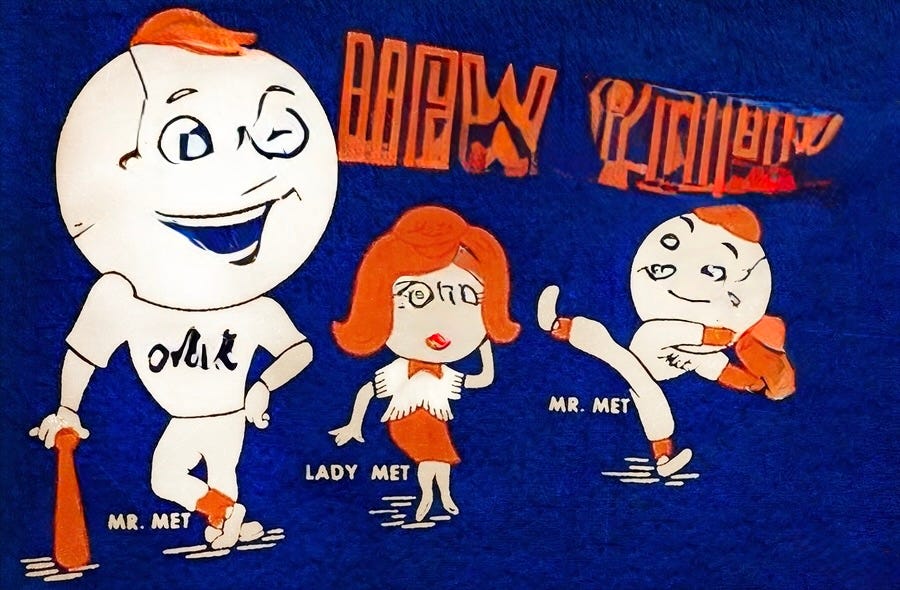
Riding the train while a Mets game is scheduled is a far more pleasant. For one thing, Mets fans who are from the same place that I am from are far less numerous. Another thing about Mets fans is that they are extremely polite to the point of deference. No, they are subservient. They know in their bones the absurdity of being who they are, this sense of superfluity that stings up and down their spinal column. If I met a Mets fan on the 7 train, and I told him to get down on his hands and knees and lick the floor for my amusement, he would not refuse me; for he has the muscle-memory of perfect obedience. I would never do this, of course. Less out of any kindness than to avoid the prurient temptation of entertaining the validity of slavery under bespoke conditions. Because once America reaches the nadir of its inevitable slope toward barbarity, you know exactly where its colosseum will be and on whom the gladiators will refine their skills.
I have never been to a Mets game, but I have been to more Orioles games than I can count. I take that back, I’ve been to, like, three Orioles games. Orioles fandom is something altogether different from Yankees or Mets fandom. It is not so much a fandom as it is a complex, a distinct and chronic state of being. It mimics the volatility and ultimate futility of being in love. The Orioles fan loves baseball or love is dead; as such, the sport is never running out of ways to disappoint them. The team always loses, even when the records mark it as a win. Each loss is etched into the cosmos as a payment for the installment plan that maintains the universal order and keeps morality from dissolving into the abyss. But as with any love object, baseball itself will never be good enough for the Orioles fan. Baseball leaves their embrace at two in the morning without even so much as a note. Baseball never just wants to cuddle. It never wants to talk. Baseball is commit-phobic. The lover looks a lot like Babe Ruth. Did you know Babe Ruth is from Baltimore? You do if you know an Orioles fan. Unfortunately he moved to Boston to pursue other interests.
Regardless of anyone’s team allegiance, baseball fans are united in the belief that baseball is not only a sport, but poetry as well. No baseball fan has, to my direct knowledge, ever said this explicitly; but they do not need to. (Actually one has said just that.) Compare the widening and slight watering of the eyes of a baseball spectator to the widening and watering of the eyes of someone reading about the time William Carlos Williams ate your delicious plums without your consent or when Gottfried Benn planted a flower into the rib cage of a cadaver he was dissecting, and I challenge you to tell me the difference. In fact, you are permitted to read books during a baseball game. You are safe, the baseball fan implies, from the brutal penalties of reading during a football game, where anyone caught is thrown onto the field, hogtied, and dragged from one end zone to the other and back by a chain attached to a running back’s waist. Baseball is sportsmanship embodied, which respects discipline, feeling, and beauty, not unlike poetry. Football is the prose of sports: dense and clumsy in defeat, cold and Spartan in victory.
Even after all that, though, the maxim is resilient. There is no crying in baseball because nothing happens in baseball. Rather you have remodeled it to say that there is crying about baseball, crying over baseball, crying into baseball, and crying through baseball. Your tears cascade upon baseball into such a volume that baseball struggles to preventing sinking into it, dog-paddling in the oceanic expanse of your sadness, without no shoreline in sight and no rescue on the way. And that is after all of the upper layers of available emotion have been imposed upon it wilted on contact as they inevitably do.
Maybe it’s better to dispel a different maxim: that you can be and often are “inside baseball.” Clearly it is more truthful to say that baseball is inside you. Baseball is the charming manipulator, the potent and irresistible infector. It promises you everything only to end up taking more than it gives back. But you can hardly complain. You and baseball make up the toxic pairing par excellence. You drown it, but it loves the feeling of drowning. It pulls your emotions to the precipice of sanity, but you yearn to fall into its bottomless chasm. So far as I am able to gauge, anyway, as it should be clear by now that I don’t like baseball all that much.