
Peak Frolic
A dumb memory.

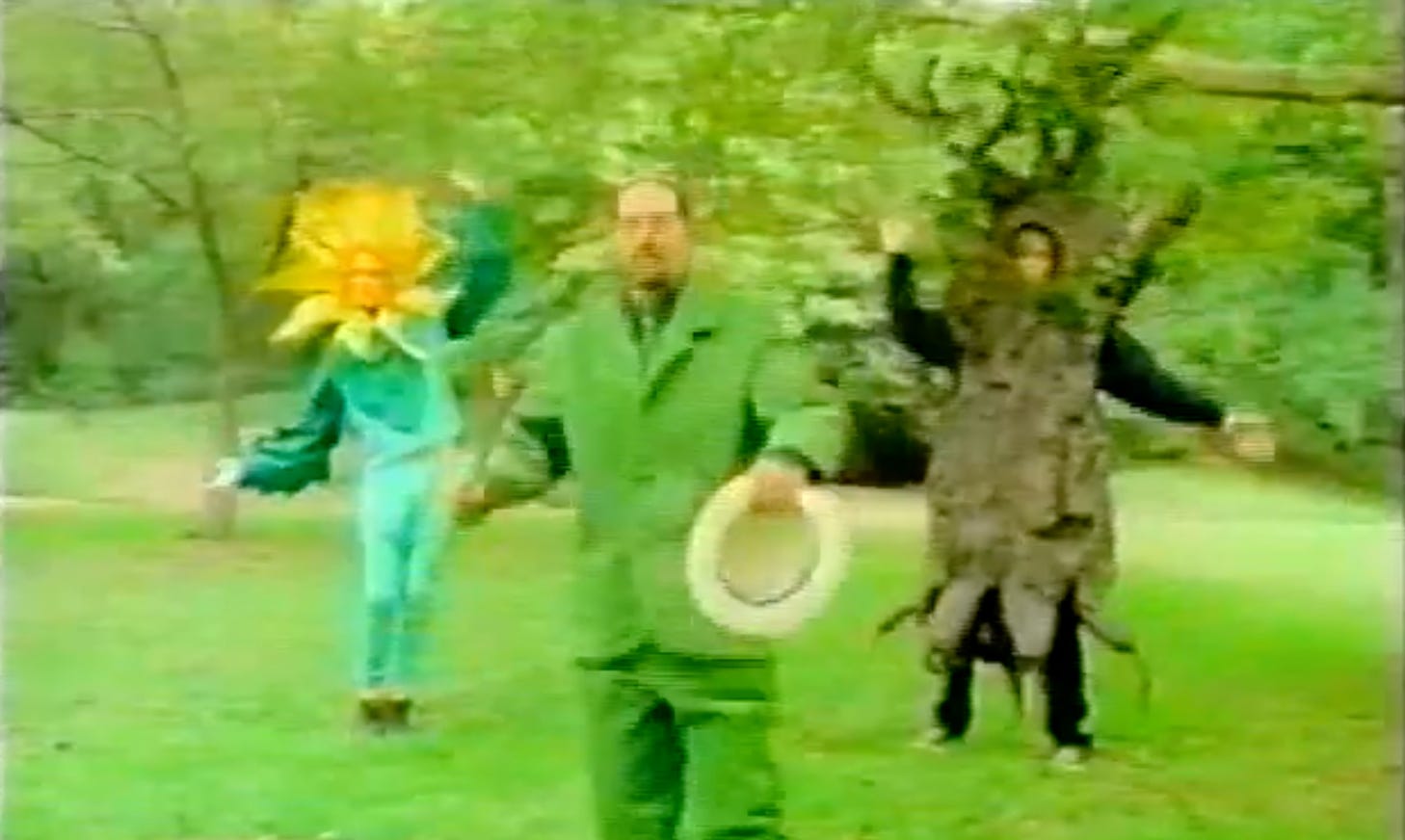
When I was a child, I went to frolic in a majestic forest by my lonesome, as dumb children in New Jersey are wont to do. But as I reached peak frolic, I lost my way and stumbled onto a dark hidden glen, overgrown with gnarled trees and of musty, dewy smell.
At the center of the glen was a mound of moss that appeared to be undulating as if it was breathing. Being as dumb in that moment as I was right before I entered the forest, I approached the mound, and held out my hand to touch the surface. This act was dumb indeed, for as my hand made contact with the moss, its writhing intensified and seemed to spread outward until it was under and a bit beyond my feet.
Then the mound rose upward, the ground parted, and, like a rupturing blackhead, revealed a new mass concealed from under it. When it stood in complete display it was most unusual. The bottom was a mass of mud, roots, and vines, which as I looked further up turned into the strands of a long gray beard that was growing from the head of an old man. A plant man, if you will. In addition to his obviously advanced agedness, he bore an especially withered countenance one sees in a graveyard shift 7-11 cashier, or someone’s dad getting home from work. Even in my unimpeachable dumbness, it was clear I’d committed an error.
“Child,” the old man said in a grave tone of voice that grated the ear canal, “you have disturbed my slumber.”
At which point I fled the forest in abject terror, never to venture into it again. Though I was dumb, I was not stupid.
Yet had I stayed and, contrary to my gut suspicion, not been devoured instantly by the unpleasantly awoken old man of the forest, I think the encounter would have gone thus:
“Come hither, child,” said the old man, probably, “and let me tell you a parable [or fable or truism or whatever] that may aid you in your life’s journey.”
Just then, a small tree stump fitted to my small dimensions, and with comfy back support, rose from the ground, and on which the old man told me to sit. Having done so, he began his tale.
“Once upon a time,” said the old man, “there was a village not so different from the one where you live.”
I took his word for it and bade him to continue.
“In this village there were two kinds of citizens. One kind was the right people, the other kind was the wrong people. The right and wrong people shared many of the same customs. And the casual observer might not even see any distinction between the two. But the difference was real enough. Both, for instance, wore hats outdoors. But where the right people wore their hats the right way, the wrong people wore their hats the wrong way. Both kinds bore children. But the right people bore children the right way, and the wrong people bore children the wrong way. If you know what I mean.”
Being still a child and still no less dumb at that moment than at any that preceded, I had not the faintest fucking idea what he meant, but implored the old man to explain further seeing as how we’ve already gotten this far.
“As you might have guessed, the number of right people in the village was notably, though not overwhelmingly, higher than that of the wrong people. But if they wanted to, they could increase their numbers by persuading the wrong people, with varying degrees of implied force, to adopt rightness. For while it was possible to be born wrong, they were not doomed to die wrong. Indeed, right people of the past were more insistent on that point. No method was too excessive, no justification too flimsy, to convert the wrong people toward rightness.
“Now these right people—the new right people—were a bit different. While being altogether certain of their rightness, they didn’t feel any urgency to spread it around. For the sake of variety, the right people decided it was better to tolerate a healthy supply of the wrong people.
“The wrong people were always apprehensive over the right people’s clear ability to assert their dominance, but they found this softer arrangement satisfactory. Though wrong to every measurable degree, their wrongness was given free rein, and not just in the privacy of their homes, but out in public forum and in the presence of right people.
“In time, however, the wrong people began to notice something strange in how the right people regarded them. Though they seemed to listen intently enough to all the wrong things the wrong people had to tell them, they did so at a careful remove, as if the wrong people were doing a neat card trick or the kind of striptease act where the girl just moves feathers around suggestively. This made the wrong people suspicious. They realized that they worried so much about being imposed upon that they didn’t notice they were being more subtly contained. The wrong people felt that this was not at all suitable.
“The wrong people thought long and hard about how they might reverse their fortune. Then the answer occurred to them. ‘Of course,’ said the wrong people in unison, ‘we’ll just carry ourselves as if we’re right!’
“And so the wrong people conducted themselves accordingly. Though still displaying their confirmed wrongness, the wrong people behaved as though wrongness was right, and had been right all along. They assumed the same measure of certainty as the right people, and in fact came to appear more certain in comparison.
“This, to say the least, rubbed the right people in the wrong way. At first they thought a sickness had fallen upon the land, causing mass delusions and flights of the most surreal fancy. But the wrong people, being ever robust in health and lucid in thought, dispelled this hypothesis. The right people were caught unawares and had little recourse. The right people instead grew very concerned about the decisions the wrong people were making. ‘You haven’t seemed like yourselves,’ the right people said. ‘You run the risk of giving offense. And for what, exactly? Being right isn’t all it’s cracked up to be.’
“At this, the wrong people kindly suggested that the right people go fuck themselves.
“The village soon fell into disharmony. This was not ideal to the right people; but not a few of them were happy that at least the tiresome business of being polite to the wrong people was behind them. This, they thought, is something they could live with.
“But something utterly unthinkable happened. Right people began to embrace the wrong things. Evidently, the wrong people were conducting their own countermeasures against containment; telling right people that being wrong was still wrong but far more interesting and thrilling than being right. Being right was lame af. A sufficient number of right people found this persuasive, and could be seen cavorting openly with the wrong people. The wrong people were kind of fun in a way only people not used to responsibility could be.
“The right people could only respond that they, too, were fun; the most fun, in fact. And they mandated the remaining right people to partake in examples of the kind of fun they like to have as obvious proof. But by then it was too late,” the old man started to trial off.
“So what happened next?” I asked.
“That depends on whom you ask. The wrong people will insist that the right people lost patience with them and suppressed them and their ways like old times. The right people will insist that they waited it out until the wrong people, being all wrong, brought defeat upon themselves and surrendered willingly. But by that point everyone lost track of who the right people and the wrong people were. And so the people outside the village who had to hear all this decided to take matters into their own hands, demolishing the village and paving it over with something of more eminent usefulness.”
“What’s that?”
“An outlet mall whose backers pulled their investments halfway into construction,” he said. “The end.”
“So … what’s the moral?”
“Moral? I don’t know, I just needed to buy time while the vines restrained your ankles.”
I looked down and, true to his word, while listening to the parable, I was rendered immobile by deceptive flora.
“Now,” said the old man with a wide grin, “I will eat you, then use your bones to make a kite. I’m not sure that this is the best place to fly a kite, but the forest is very boring, and I need to try something.”
So, officer, I think that should answer your question as to why I’m lugging these canisters of gasoline and these bags of newspaper into these woods. Now if you’ll excuse me, I still have much to do.